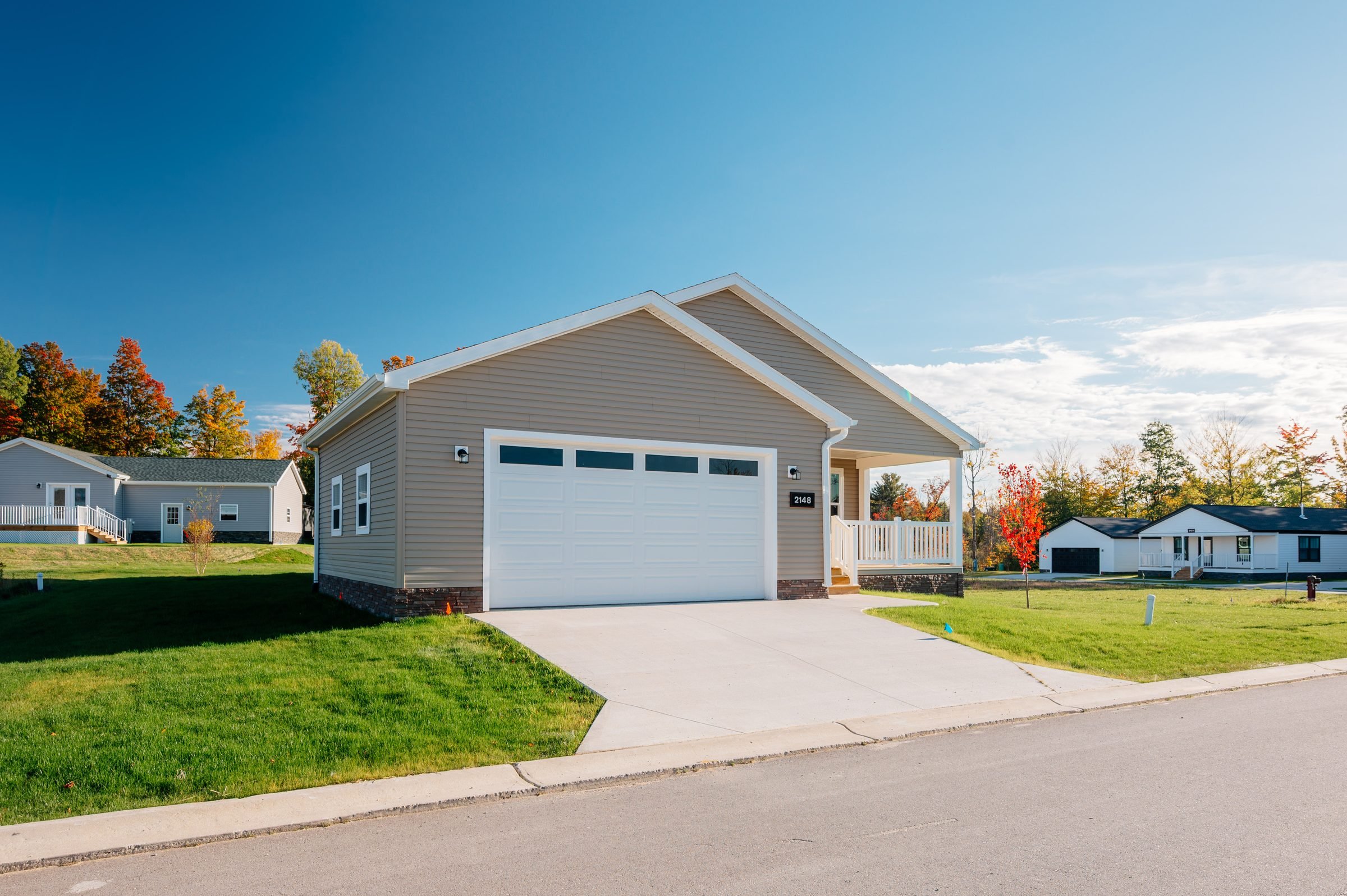
Every new manufactured home has a little bit of plumbing that lives outside the heated part of the house. It's short, it's under the floor, and in a Traverse City January it's the part of the home most likely to give you a bad morning. This post is about how that plumbing is protected when the home is built and set, and what you, as the owner, look at before and during winter.
I'm a Realtor, not a plumber or an electrician. So everything below that sounds like a rule comes from the federal code or a safety agency, with a link, and the practical stuff is the kind of thing buyers ask me on tours.
Where the water comes in
A HUD-code home sits on piers with a crawlspace under it, closed in by skirting. Your water comes up out of the ground on a riser, under or right next to the home, and connects to the home's cold water inlet. The federal installation standard says there has to be an identified, accessible shutoff valve between the supply and that inlet, and it has to be a full-flow gate or ball valve.
Find that valve the week you move in. Not in February with water on the floor.
On a double-section home there's also a crossover, the water line that joins the two halves. That same section of the standard says crossovers finished during installation have to be protected from freezing, and that exposed supply piping, shutoff valves, pressure reducers and pipes in the water heater compartment have to be insulated or otherwise protected where it freezes. Here it freezes.
What the code requires the factory to build in
The construction standard, 24 CFR 3280.603, says piping and fixtures subject to freezing have to be insulated or protected so they won't freeze under normal occupancy. The manufacturer has to give written instructions for how that's done, a statement that any heat tape or pipe heating cable used must be listed or certified for the purpose, and a dedicated outlet for it.
That outlet is spelled out in 24 CFR 3280.806(d)(10): on the underside of the home, within 2 feet of the cold water inlet, on an interior circuit that isn't a small appliance circuit, and on the load side of GFCI protection. So if you crawl to the inlet with a flashlight, there should be a receptacle right there. If the heat tape is plugged into an extension cord running out of the garage instead, something's off.
And the home's installation manual is the document that says which method your particular home uses. Keep it with the title paperwork. I don't know offhand what every manufacturer specifies, and the manual is the only answer that counts for your home anyway.
Heat tape is useful and it can also start fires
The U.S. Consumer Product Safety Commission has been warning about this for decades. In a 1996 release it estimated about 1,500 fires, 10 deaths and 100 injuries a year from faulty heat tapes, and it called out mobile homes by name, since that's where the tape usually lives. Its advice still reads like a fall checklist:
Plug the tape into a grounded, GFCI-protected outlet. Put it directly on the pipe, never on top of the insulation. Don't wrap it over itself unless the instructions allow it. Keep the end cap sealed and off the ground. Don't cover it with foam or vinyl insulation that could burn if the tape fails, and only cover it at all if the tape's maker says to. Once a year, look it over for discoloring near the plug, charring, cuts or bare wire, and replace it if you see any.
My flat opinion: a new home has new tape, but you still look at it every fall. It takes five minutes and a flashlight.
The skirting and the vents
Skirting keeps wind out of the crawlspace, and that does a lot of the work of keeping those pipes warm. The installation standard, 24 CFR 3285.505, requires ventilation openings in skirted crawlspaces, and in places that freeze those vent covers have to be adjustable so they can be opened or closed with the seasons. It also requires an access opening at least 18 by 24 inches, placed so the utility connections under the home can be reached.
Two practical things follow. Check that the access panel is latched and the skirting has no gaps after the first big wind. And don't stack firewood, a snowblower or bags of salt against that access panel, because the day you need it you'll be digging.
Inside the house, on the coldest nights
The American Red Cross has a plain frozen pipes page that's worth a read. The parts that fit here: drain and store garden hoses before the first hard freeze, open the kitchen and bathroom cabinet doors on very cold nights, let cold water drip from a faucet served by exposed pipes, keep the thermostat the same day and night, and if you travel, leave the heat on no lower than 55 degrees. If a faucet only trickles, keep it open and warm the pipe with a hair dryer or heating pad. Never use an open flame.
But if you can't find the frozen spot or can't reach it, call a licensed plumber. That's the Red Cross's advice too.
Who handles what at Alta Vista
At Alta Vista the community takes care of the streets, the sewer system and snow in the common areas, and you take care of your home inside and out. The amenities page lays out that split, and the FAQ covers the rest of what site rent includes. So the shutoff, the heat tape, the skirting and the cabinet doors are yours. If you're not sure whether something under your home is yours or the community's, call Clinton Herigstad at the community office, (231) 421-7328, before you start unscrewing things.
If you're still shopping, ask to see the water inlet and the heat tape outlet when you tour any of the homes for sale. It's a fair question on a brand new home, too.
Checked against the sources linked above in November 2026.
If you want to see it in person, text Taylor at (231) 360-1510 or schedule a tour.
